
Understanding EEF1A2. Advancing Research. Creating Hope.
An independent family-led initiative investigating the rare EEF1A2 D91N variant and supporting research into EEF1A2-associated neurological disorders.
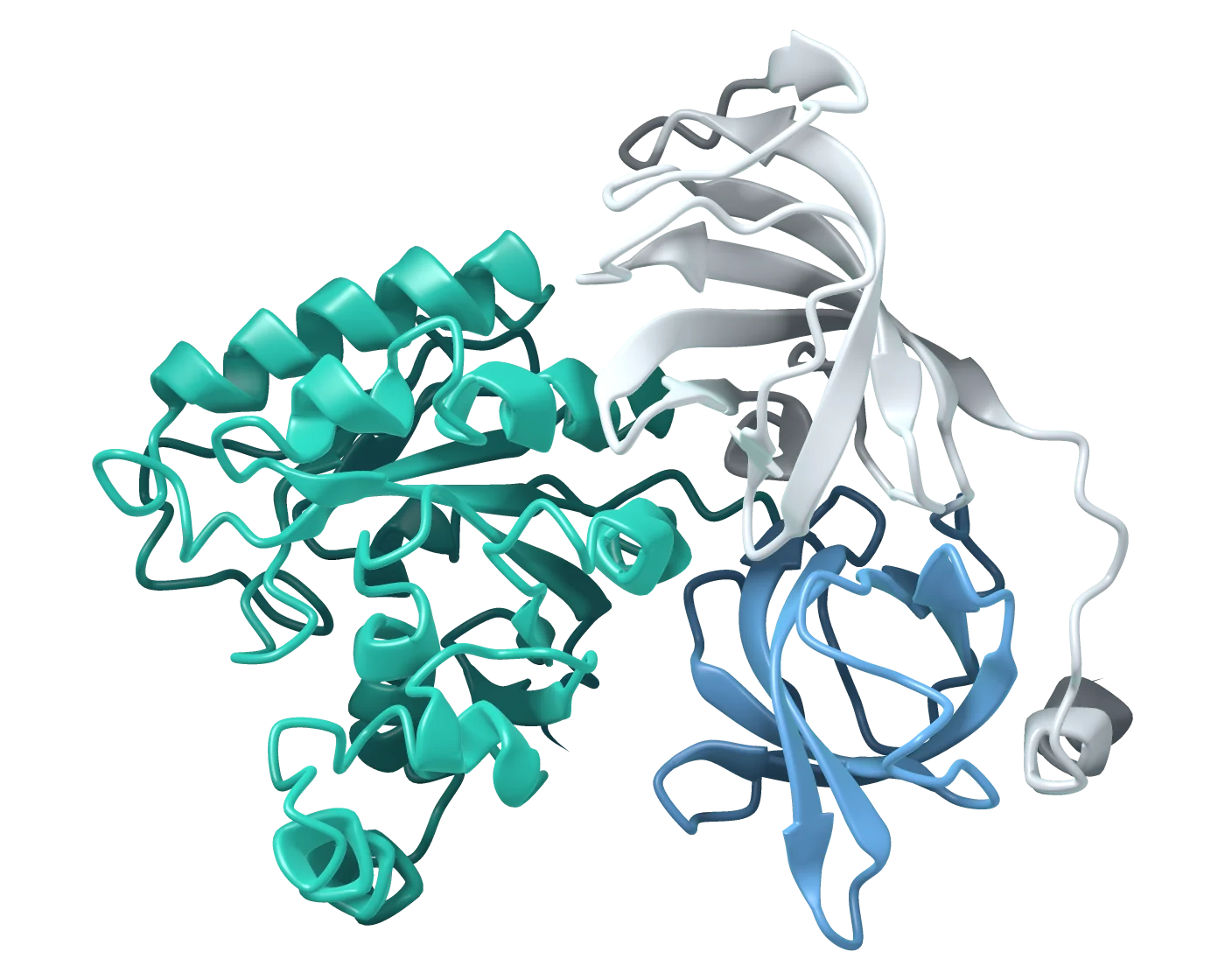
Illustration and logo: predicted structure of human eEF1A2 from AlphaFold DB, entry AF-Q05639-F1 (© DeepMind Technologies Limited, CC BY 4.0), redrawn as a ribbon model and coloured by approximate domain. It shows the normal protein, not the D91N variant.
What EEF1A2 does, and what goes wrong
The biology of eukaryotic translation elongation factor 1 alpha 2, the clinical spectrum reported in the literature, and a searchable database of published variants — every statement tied to a source you can open.
Our researchInvestigating D91N
A molecular dynamics investigation of the D91N substitution is under way with an independent collaborator on high-performance computing resources. The analysis plan was fixed in advance of looking at the data.
CollaborationLooking for a laboratory
Our next objective is a collaboration with a university or qualified research laboratory to investigate this variant experimentally. We have no formal institutional partnership at present.
The D91N variant
Our son carries a heterozygous NM_001958.3:c.271G>A, p.Asp91Asn variant in EEF1A2. Here is the published record we have been able to verify for this specific substitution.
What is documented
- Reported in three published individuals, each de novo, with clearly different courses.
- Classified as pathogenic under ACMG criteria in one report and as likely pathogenic in another; listed as pathogenic in ClinVar.
- Disrupts protein function in a yeast complementation assay, and its protein levels were reduced when the equivalent substitution was expressed in yeast.
- Placed directly adjacent to the switch II helix in structural modelling — adjacent to it, not within it.
What we will not claim
- That D91 contacts the catalytic magnesium ion or the nucleotide. No source we have read states this, so the site does not either.
- That D91N is a loss of function, or that it is a toxic gain of function. Neither has been shown for this variant.
- That findings from G70S, E122K or D252H apply to D91N. They are different substitutions in different structural contexts.
- That our simulation has demonstrated a functional defect. It has not; the analysis is ongoing.
For researchers and clinicians
If you work on translation elongation, GTPase structural biology, developmental and epileptic encephalopathies, or ribosome quality control, we would value your time — including the kind of reply that tells us a line of reasoning is wrong.
We are a family, not a laboratory. What we can offer a collaborator is a thoroughly documented single-variant question, a complete and honestly annotated literature base, and a family willing to do the unglamorous work.
- Molecular dynamics — running, analysis plan pre-registered, results not yet available.
- Experimental collaboration — sought, not yet established.
- Institutional partnership — none at present.
- Funding — a private campaign run by the family. No grant, no institutional funding.
Medical disclaimer
This website does not provide medical advice. It is an information and research platform. Nothing here is a diagnosis, a treatment recommendation, a dosing instruction or a substitute for care from qualified professionals. Mechanistic reasoning is not clinical evidence, and a hypothesis on this site — however carefully argued — is not a basis for any decision about any individual. If you are affected by an EEF1A2 variant, discuss your situation with your treating physicians and clinical geneticists.
Full text: disclaimer, privacy and site policies.
References
Rendered automatically from the site bibliography. Each entry states how far the source was actually read — a database record, an abstract, or the full text — because that distinction changes how much weight a citation deserves.